Showing posts with label Current Events. Show all posts

Sunday, October 18, 2020

In Defense of the Astros

I am glad to be writing this post as an irrelevant digression rather than a timely attempt to wrap one’s mind around the possibility of a team with a 29-31 regular season record winning the World Series. My standard outlook when watching the playoffs is to pull for the better team. This is not an ironclad rule, as I do allow my various prejudices (fandom, a favorite player, a least favorite player, style of play, etc.) to override the general principle. I also do this despite being unable to be truly surprised by any outcome of a seven-game series between any two legitimate major league baseball teams. That it does not at all surprise me when inferior teams win series against superior teams, and while it can occasionally be fun to see this happen just to see the egg on the face of people who wildly overestimate the probability of the better team winning (for me, the 2010-11 Phillies were the archetype of this phenomenon), I generally find it disappointing.

After Houston tied the series at three, though, and as I read some online reactions to the possibility of them appearing in the World Series, I decided it would be worthwhile to explain at length why I do not feel that they would be an illegitimate champion should it come to pass. The fact that it did not come to pass makes this discussion academic, but look at where you are. One thing that should be said upfront is that given the emotion generated by the Astros, it is impossible to disentangle how much of the backlash to the possibility of them winning was rooted in genuine concern about the legitimacy of the outcome of the MLB season (concerns that, I have argued, would have been much better channeled towards the possibility of Miami advancing deep into the playoffs), and how much is simply rationalization for the often disproportionate reaction to the sign stealing scandal. There are also people who are looking for any reason to discount the 2020 season, whether out of allowing the perfect to be the enemy of the good (I just cannot relate to people who would rather see no season than 60 games; neither can the bank accounts of the players), or out of darker authoritarian and totalitarian impulses. Arguments borne from there are outside the scope of this piece – this is about the implications of a 29-31 team appearing in or winning the World Series.

The first question that should be asked is “How good are the Astros, really?” My answer is – almost certainly better than 29-31. Why do I say that?

1. The Astros underlying performance was better than their win-loss record

The Astros scored 4.80 and allowed 4.72 runs per nine innings, which in a world of nine-inning games would be expected to result in a winning percentage of .508. The Astros tallied 4.58 runs created and 4.50 runs created allowed per nine innings, which in that same world would also be expected to be allowed in a winning percentage of .508.

Of course, this is not significantly or in any way meaningfully different than their actual W% of .483, but if you have a psychological hangup on a sub-.500 team winning a pennant, their underlying performance was ever so slightly better than that of a .500 team, and to the extent that these tiny differences mean anything, they should mean more the smaller the sample size of games actually is.

2. The Astros win-loss record would likely have been over .500, even at their same level of performance, had a normal schedule been played

Last year, the AL West was the best division in MLB, with an average schedule-adjusted W% of .527 (of course, the Astros as the best team in baseball contributed much to this). The NL West was third at .510. While such calculations cannot be made for 2020 because of the lack of inter-geographic games (we can add the playoffs in, but they don’t provide a sufficient sample to be relied upon, although it is hard not to notice the complete playoff decimation of the Central), my guess is that playing a western-only schedule was tougher than the average schedule faced by a MLB team. This also suggests a slightly better than .500 true performance.

3. Most importantly, the Astros’ true talent was significantly better than that of a .483 team

Some time before the season, I grabbed the win projections from three sources that I think do quality work on these sorts of questions: Baseball Prospectus, Clay Davenport, and Fangraphs. Their win projections for the Astros were 36, 36, and 35. Respectively, that put them second, first, and tied for first in the AL (I should note, I didn’t record the date I jotted down these numbers, so they may not have represented the final estimate from each source).

Of course, things changed, most notably the injuries to Justin Verlander and Yordan Alvarez, but these are insufficient to take a 35 win team to under .500. Some Houston hitters (particularly Jose Altuve) had poor seasons that might have recalibrated estimates of their true talent, but how much stock can you put in sixty games of additional data, and there are players going the other direction too (Framber Valdez is a big one). It seems highly likely that the Astros underlying true talent was that of a winning team.

I note this not to self-aggrandize (heavens knows I’m wrong about these things more than I’m right), but rather to cover myself in case anyone looks back at my 2020 Predictions post, I actually did not pick the Astros to make the playoffs under the traditional format, but did once the field was expanded. While I did not expound on my logic, I did think the Astros were more vulnerable than the purely objective approaches did, mainly because I thought that a starting staff anchored by two pitchers older than me was not a foolproof plan (even if they are Hall of Famers to be). I actually picked the Rays to win the AL pennant, which didn’t take any particular insight but viewed in the wrong light could discredit the opinions I’m expressing here.

If you now will accept the premise that the Astros 1) performed like a winning team 2) would have been a winning team against a normal schedule and 3) could expect to perform better over any stretch of future games due to their underlying talent, are the Astros in fact a beneficiary of a sixty-game season – or a victim? I would argue the latter – the 2020 Astros were a good team that happened to have a mediocre record, largely caused by a season with a schedule that was too short and too unbalanced.

I don’t know what the purpose of a playoff system is (actually I do – it’s to make money). Is it an attempt to reward the teams that performed the best in the regular season? (I’m pretty sure it’s not). Is it an attempt to identify the best team, treating the regular season only as a means of culling the herd? (I think many fans feel this way, which I think is crazy). In reality it is likely some combination of all three. But if the point of a playoff system is to use the regular season to cull the herd, then attempt to identify the best team, I am far from convinced that the Astros should not have been a beneficiary of such a system. And while I would generally consider such a system foolhardy, it is certainly more defensible when the regular season used to do the culling is only sixty games – we should have much less confidence that the results of the sixty games should count for more than the results of the playoffs than we normally would be.

To put this into quantifiable terms, let’s suppose that we decide that in order for a champion to be legitimate, they have to meet some minimal standard of competence. We could then test the worthiness of a champion by calculating the probability that a team that met that minimum standard of competence would have compiled a record equal or worse than the team in question.

For example, let’s say that we decree that in order to be a worthy champion, a team should be at least a true .556 W% team. This is of course an arbitrary value; I’ve chosen it because it corresponds to a 90 win team, which is a value I have always subjectively thought of as marking a legitimate contender. So under this argument, we will accept the playoff result as legitimate, to the extent that the champion it produces was in fact a 90 win quality team.

Using the binomial distribution, it is simple to calculate the probability that a team with a given W% would have a record of 29-31 or worse. The probability of a .556 team going 29-31 or worse over sixty games is 15.8%. Contrast this with the Rays, who were 40-20, which would happen with probability 97.0%.

What would an equivalent performance to Houston’s 29-31 be over the course of 162 games? A .556 team would win 83 or fewer with a probability of 14.9% and 84 or fewer with a probability of 18.9%. The 2006 Cardinals won the World Series after going 83-78 (darn that missing game; the probability for 83-78 is 17.0%). So if you demand that your world champion be at least a .556 team, you could plausibly argue that the Astros would have been the least worthy champion in history. (I would in fact argue that the Astros were more worthy under this criteria based on the considerations discussed above, particularly strength of schedule since it remains grounded in actual wins and losses rather than component performance or true talent).

But .556 may well be setting the bar too low. Is it too much to demand that a world champion be a .600 team (equivalent to about 97 wins)? One could certainly argue that it is not – the champion should be a team that has demonstrated excellence, not simply a contender.

The probability that a .600 team would win 29 or fewer out of 60 is 4.4%. Conveniently, the probability that a .600 team would win 86 or fewer out of 162 is 4.4%. So under this formulation, the Astros could be seen as an equally worthy champion to a team that went 86-76 over a full season. The 2006 Cardinals are joined by the 1987 Twins (85-77) in not clearing this bar, and the 2014 Giants (88-74) were close as well. Of course, in all cases I would argue that we should at least adjust actual wins for strength of schedule, but I think this suffices to make the point. One can make a very logical case that a 29-31 team would not in fact have been the least worthy World Series winner in history. (I am only going to hint at the low hanging fruit offered by the sixty-game record of the reigning world champions who denied a much more worthy team called the Astros in 2019).

Tuesday, July 28, 2020

Chutzpah

Step 1: Advocate tirelessly for baseball to be shutdown, along with anything else that your political masters deem “non-essential” (all while being completely oblivious to how totalitarian this all is, as you not only no longer claim to be guided by liberal values, ideals, or principles, you and the political movement you follow have completely lost the ability to even think in terms of liberal values, ideals, or principles).

Step 2: Baseball (and other “non-essential” means of voluntary economic cooperation between individuals that provide the livelihoods for the people who buy your subscriptions and advertise on your website) gets shutdown.

Step 3: Shockingly, your revenues from subscriptions and advertisements declines.

Step 4: Ask me for money so that you can cover the activity that you tirelessly advocated to be shutdown.

Hard pass. I’d wish you good luck, but I wouldn’t mean it.


Wednesday, July 08, 2020

April 4, 1994 pt. 2

I’ve previously written about the Indians/Mariners opening day game of April 4, 1994 that made me a baseball fan. I won’t rehash all that in detail again, but I recently was able to watch a replay of this game for the first time. I’d never actually seen any of it before, except for highlights – in real time I listened to about the seventh inning forward on the radio.

For the rewatch, I kept a scoresheet, which is reproduced at the bottom of the post. A few observations:

* Chris Berman and Buck Martinez called the game on ESPN. Berman was not as terrible as I remember him being, but most of my exposure was later. That is not to say that he was good. Martinez is a middling announcer with a terrible voice, and was in 1994 as well. It would be a real treat to be able to watch this game with the local radio call of Herb Score and Tom Hamilton that I would have enjoyed in place of the national guys.

* Randy Johnson had a no-hitter through seven, which was noteworthy for reasons beyond the obvious. As all Indians fans know, Bob Feller is the only pitcher to throw an Opening Day no-hitter, and here was a threat to no-hit the Indians in on Opening Day in their first game in their new park with Feller on hand. Plus Randy Johnson, while not yet the legend that he would be, was obviously a legitimate no-hit candidate. He’d already thrown one in 1990, and 1993 had been his breakout year, finishing second in the Cy Young voting and recording his third straight season with over 10 K/9.

So not having seen the game and filling in the details in my mind given what I knew about the Big Unit later, I assumed that he had spent the first seven innings carving Cleveland up. But that was not the case at all; it more resembled what you would have expected a Greg Hibbard no-hit bid to look like. Through seven, Johnson had walked four and fanned two on 94 pitches. His twenty-one outs were distributed as:

12 on groundouts (including 2 DPs)
5 on flyouts
2 on strikeouts
1 popout
1 caught stealing

His opposite number, Dennis Martinez, was pitching a similar game from a DIPS perspective with one big exception – the two out solo shot he yielded to Eric Anthony in the third. Otherwise, through seven Martinez had struck out four, walked four, and hit Edgar Martinez in the first inning (providing an early injury scare as Mike Blowers pinch-ran, all this after Martinez had appeared in just 42 games in 1993. He’d only appear in three more games the rest of April).

* Two future stars were languishing down in the Indians lineup – Manny Ramirez batting eighth, and Jim Thome on the bench. It would be some time before Thome was trusted to start against left-handed pitchers, and so Mark Lewis was the ninth-place hitter and third baseman. Ramirez provided a Manny being Manny moment. After Candy Maldonado walked to open the eighth and Sandy Alomar singled to break up the no-no, Manny clanged a 1-0 Johnson offering off the big wall in left for a game-tying double. With Mark Lewis looking to advance the go-ahead run to third base, Ramirez strayed two far off second and was picked off by a Dan Wilson throwback to second on the first pitch.

Ramirez and Thome were never in the game simultaneously; with the Indians down a run with one out in the tenth, Ramirez drew a walk and was replaced by pinch-runner Wayne Kirby. It was then that Thome batted for Lewis, which brought on lefty reliever King for Seattle. Thome pulled a double down the right field line to put runners at second and third, and Kirby would later score when Vizquel hit into a fielder’s choice. It would work out in the end two, as Kirby walked it off in the eleventh with a two-out, line drive single to left to score Eddie Murray with the winning run.

* Despite what I’m about to say below, this was a good game for star power as these two teams would emerge as top AL contenders of the latter half of the nineties: Hall of Famers Randy Johnson, Ken Griffey, Edgar Martinez, Eddie Murray, Jim Thome, future Hall of Famer Omar Vizquel, would have been Hall of Famer Manny Ramirez, should be Hall of Famer Kenny Lofton, could have been Hall of Famer Albert Belle, a former Rookie of the Year in Sandy Alomar, and other memorable names including Jay Buhner, Carlos Baerga, Tino Martinez, and Jose Mesa.

* One thing that struck me in re-watching it is what an ordinary game it was. Granted, given the circumstances (opening day and opening game of a new park) it was extremely memorable for Indians fans, but if you strip all that out and just evaluate it as a game, it wouldn’t be the most exciting of most major league team’s seasons. I have personally attended at least six Indians games in the last four seasons that were more compelling, and I’ve only been to about sixty games in that time and I’m making that list from the top of my head. I had built it up in my head as a kind of epic, and in some senses it disappointed upon rewatch.

On the other hand, that disappointment reminded me of what a great game baseball is. I have now watched twenty-six seasons of major league baseball and perhaps become jaded about just how interesting and exciting baseball inherently is. That this game wouldn’t rank in the top 10% of games I’ve attended recently speaks to what an amazing game baseball is. Since this game was sufficient to almost instantly turn me into a baseball nut, I suspect that a much less exciting contest would have done the trick. And it should have...I’m repeating myself again, and as I write this we are still two and a half weeks from even the possibility of baseball in 2020, and that too reminds me that baseball is just the best in every way.

* More generally on the franchise that I yolked myself to on April 4, 1994, I have no comment on the fact that the Indians will liekely soon be changing their name itself. I do have two strains of thought on possible future names:

1. I think “Expos” is the logical choice, which is a snarky way of saying that my suspicion is that this name will be changing again in the relatively near future as the franchise settles into its new home in Montreal, Nashville, Portland, Las Vegas, Charlotte, etc.

2. “Spiders” is a dreadful option. First of all, as a general philosophy, I believe that baseball team names should be non-threatening. Most baseball team names are – I would contend that the only exceptions among the sixteen teams dating to 1901 or earlier are Pirates and Tigers, depending on what you think (very carefully) about Braves and Indians. Cubs are not an animal I would wish to encounter, but the name suggests cute and cuddly teddy bears rather than miniature grizzlies. Among expansion team names, the only one that I would classify as even mildly threatening is Rangers, and I would suspect the desired effect is strength and honor rather than menace.

The exception is the 1998 expansion. The Devil Rays and the Diamondbacks both sound threatening, although the former is actually generally harmless (to humans at least, and I think that’s all we should consider lest all the bird names become threatening) and was later downgraded to the double meaning “Rays” anyway. The latter is a scary animal, but is also in my opinion a contender for best expansion team name, due to the baseball tie in (my other contender for best expansion team names would be Brewers (although that was recycled), Colt .45s/Astros, and Pilots/Mariners. The latter was a case in which the city had a great name and then got a similar yet superior one eight years later).

So I would contend that Spiders is contrary to the spirit of baseball nicknames. The history of the name is also quite problematic (although quite appropriate if my misgivings about the future of the franchise are founded). The original Spiders represented Cleveland in the National League from 1887-1899, never winning a pennant. In the early 1890s they were a strong outfit, finishing second three times and even capturing a Temple Cup (which I do not in any way deem to be comparable to a regular season pennant) with names like Cy Young and Jesse Burkett, but were soon a victim of the systemic corruption of the 1890s NL, with owner Stanley Robison siphoning off talent for the St. Louis now-Cardinals in which he also had a stake. As you probably know, this culminated in the 20-134 debacle of 1899 before the team joined Detroit, Lousiville, and Washington on the chopping block, leaving Cleveland open for Ban Johnson’s play at major status for the American League two years later. I would contend that this is quite an ignominious history and nothing to be celebrated or emulated.

If Cleveland’s major league history must be the first source of inspiration, the Indians’ prior unofficial names won’t cut it: Blues is boring, Cleveland isn’t supporting a team called the Broncos, Naps would be fine with me but doesn’t sell and the headlines write themselves. The Players League outfit was referred to as the Infants. The Negro Leagues don’t provide much in the way of an option, as Cleveland’s proudest entry was the Buckeyes, a name of which THE sports team of only entity is worthy.

I do think there is one Cleveland major league name that would work – the first, the Forest City club which represented the city in the National Association during 1871-72. This team actually participated in the NA’s first league game on May 4, 1871. Maybe you’d have to rework it to Foresters (or even Sawyers), but it’s a name I could get behind.

Best non-historical choice, although semi-violating my own suggested rule about nice namesakes: Buzzards.


Monday, February 17, 2020

All I Have to Say About the Astros

I have always been completely unable to relate to people are so weak-minded that they demand that history literally be rewritten to fit their own value judgments. If you want to judge/discount the accomplishments of the Astros, you have complete freedom of conscience to do so. Why do you need some authority figure to tell you how to think?

Of course, most of the people who demand asterisks and vacated games and forfeits and all of the other Stalinist trappings of the NCAA, IOC, and other contemptible organizations are already quite busy making their own value judgments about every damn thing in the entire world, thank you very much. If they just wanted some authority to tell them what to think, they would be sad, pathetic little creatures, worthy of the pity of free-thinking individuals and nothing more. But that's not what they want - they want some authority to tell me what to think. They seek to shift the burden of proof, as it were, from those who would deny the objective facts of reality to those who would uphold them.

I didn't call it "Stalinist" lightly - in a different cultural environment, the illiberal nature of the entire endeavor would be breathtaking in its audacity and its chutzpah. Instead, it is just another day in a world of creeping totalitarianism where the acceptable avenues of thought are controlled by the armed guards of some authority or the other. Historians of the future will learn much more about the America of 2020 from the response to the Astros scandal than they could ever hope to glean from the fact that it happened.

Monday, June 20, 2016

Cleveland

I have a love-hate relationship with Cleveland.

I was born and raised in the exurbs. I left for college but eventually came back to the suburbs but only because I had to, not because that’s where I wanted to live. When it comes to sports, I always rooted for the Cleveland teams, but in all honesty have never been a diehard Cavs fan, that description being much more apt for how I follow the Indians and the Browns. Even in those cases it might not fully apply, since I pride myself on striving to be too rational about baseball to fall into the sheer emotion of fandom (post-childhood), and the Browns have been too bad for too long to not laugh at rather than lament the losses. My sheer sports fan emotions, assigning good v. evil to every game and opponent, living and dying with the team was transferred to my future alma mater around adolescence and will never be directed elsewhere.

Yet there's no question that my baseball team is the Indians, my football team is the Browns, and my basketball team is the Cavaliers. At times this has been embarrassing. Not due to the failure to win championships, but more due to the Cleveland fan culture. Cleveland fans have taken pride in their victimhood, with the heartbreaks (sometimes more real than imagined) a perverse source of pride. Where else does a 35 year distant divisional playoff game (i.e. two games removed from the championship) have a name that every young Browns fan learns ("Red Right 88")? Cleveland had some bad breaks, but more often than not they just had bad teams. Bad management, a little bad luck, and on the rare occasions when the teams had a chance to win it all, the dice rolls were not kind. But the only way one can reasonably expect to win championships is to put multiple championship-caliber teams on the field and let the chips fall where they may. Cleveland's three largely failed in that regard.

Of course, franchise ineptitude is largely not the fault of the fanbase, but there's an important distinction to be made between losing because you're bad and losing because fate didn't look kindly upon you on a given day. Cleveland fans too often conflated the two, resulting in a fatalistic feedback loop that took the former as evidence of the latter.

The other maddening element of the sports culture is the unique grip that the Browns have on the city. For all of the elation that the Cavs victory has brought, it will pale into comparison to the day the Browns win or even make a Super Bowl. The Browns still rule the landscape, and benefit from a remarkable double standard. The Indians, a franchise that has achieved more in any one of nine seasons in the last twenty-five than the Browns have in any, are struggling with attendance. There is an overwhelming cynicism towards the Indians, rooted in a lack of understanding of the economics and nature of baseball. Every trade of a free agent to be furthers the downward spiral of the relationship between the city and the team, even as those trades bring back the future objects of lament (e.g. as Bartolo Colon becomes Cliff Lee becomes Carlos Carrasco). This is not to absolve the Indians of their very real failures in drafting/international signings that only now appear to be reversing, but the Indians have run rings around the Browns and yet it is the former that I will be pleasantly surprised to see take the field in Cleveland rather than Montreal or Portland or San Antonio in, say, 2030.

Cleveland fans have also had the opportunity to root for a winner, but many have passed it up, and I cannot feel too sorry for them. In the last twenty years, OSU has won two national titles in football and been to three Final Fours in basketball. A college team might always belong to the students and alumni most dearly, but the surely the flagship state university is as much an available rooting interest as a private entity that can be moved to Baltimore at the owner's whim.

Sports irrationality aside, one thing I will say for Cleveland and Northeast Ohio is that there is a real pride in their hometown among people here. I'm not well-traveled enough to declare that this feeling is unique, but I can contrast it to my other hometown, Columbus. People in Columbus don't generally exhibit the same pride in their city that Clevelanders do in theirs. Columbus residents might be proud of OSU or proud of Ohio, but they aren't as proud of Columbus per se. Some of this may be due to sports teams; minus the recent (and so far unsuccessful) addition of the Blue Jackets, Columbus' sporting identity ties to OSU and thus more to the state than the city.

This is why it is so appropriate that Cleveland's title drought was ended about as single-handedly as one could be by one man, LeBron James. LeBron was a native son, and that meant something here. Everyone probably feels some sort of connection to LeBrown, however tenuous or forced. Mine is that LeBron and I are the same age. LeBron was a first-name basis celebrity by the time we were freshmen in high school. The night of the 2003 NBA Draft Lottery, I was in a cabin at a state park in Southeast Ohio on our mandatory "senior trip" watching as the Cavs came up with the #1 pick (and a parent chaperone insisted that they had to draft Carmelo Anthony).

LeBron was asked to shoulder the burden of the city himself, and unfair ask for anyone but especially for a rookie. And when he dragged a ragtag bunch to the team's first ever Finals appearance, he simultaneously hurt both his "legacy" in the ridiculous media environment when the Cavs were swept and obliterated any remaining thought of patiently building a worthy team around him. For the next three seasons the Cavs chased in vein, leaving him with the impossible choice of staying to try to drag this motley crew to the promised land, or going to chase titles with a group of stars.

Of course, the way “the Decision” went down was an extra gut punch, but while many Cleveland fans condemned LeBron, I’d like to think that I was fairly level-headed (this comment on The Book Blog is as intemperate towards LeBron as I got, and I still didn't lose sight of who the real villain in sports is):

The real villain in this whole thing, IMO, is ESPN. They cannot try to pass themselves off as a news outlet of any sort when they are willing to whore themselves out for an hour as a player’s personal press corps.

It has been apparent for years that ESPN wants to be part of the stories it reports on, but it has never been more plain to see then it was last night.

On another note, I do not support the childness of the Cleveland fans, but it is worth noting where they are coming from. Cleveland has not won a major sports title since 1964 despite fielding three teams (at least since 1970)--and that one isn’t even celebrated by anyone outside of Cleveland because of the NFL’s whitewash of its pre-Super Bowl history.

Yet here, nearly miraculously, was a local player who just so happened to be the best basketball prospect in anyone’s memory. He was not called the Chosen One for no reason. He was the one who was destined to finally break through the wall, to give Cleveland its championship. Twice the team has looked liked the NBA’s best team in the regular season, only to fold in the playoffs.

I’m not saying that those expectations and hopes were fair, that they all should have been thrown on LeBron’s shoulder. They plainly weren’t. Still, I may be a little biased, but I think that all things considered, this has to be one of the biggest kicks in the gut that an athlete leaving a team as a free agent has ever delivered. That doesn’t excuse Dan Gilbert or Cavs fans, but this is not just ARod leaving the Mariners.


The truth of the matter is that I was still a LeBron fan. The most endearing quality of LeBron in a sports sense to me was his support of OSU. He was on that bandwagon prior to the 2002 national championship (an article on his senior season of high school included an account of his enthusiastic celebration of this victory with his teammates), and he remained a friend of the program even after going to Miami, which he didn’t have to do. Sure, OSU is an important college asset of Nike, but Nike has contracts with a million other colleges, there was no need to keep up appearances.

It seemed like a crazy pipe dream in the spring of 2014, but was realistic by summer, and then remarkably came true. LeBron was coming back, to try to lead a new supporting cast, rebuilt largely through the fruits of the lottery picks that never would have come had he stayed (Kyrie Irving, Tristan Thompson, Dion Waters, Kevin Love via trade). For all of the fury that surrounded The Decision, had LeBron’s goal all along been to win a title in Cleveland, he couldn’t have done any better.

However, nothing is assured, and being Cleveland the natural insecurities were ratcheted up a few levels. Had the moment for LeBron passed, was he just far enough past his prime that he could not deliver? Was the supporting cast good enough (or in the case of Irving, healthy enough) to provide him support? Unexpectedly a new question emerged--would the suddenly dominant Warriors serve an insurmountable foil?

Hopefully the answers to those questions will reduce some of the irrationality of Cleveland sports observers (of course, the probability of the Cavs winning when down 3-1 was greater than the probability of a collective of sports fans becoming more rationally). Whatever small change to the city’s sports mindset might result, Cleveland’s overall inferiority complex is not going to change. On the very morning after the Cavs won the world championship, a new banner appeared on the side of a building bragging that the first traffic light was installed in Cleveland in 1914. This will certainly make the political hacks in town next month to do political hack-y things real impressed. Cleveland is a weird place.

And yet I can watch a ridiculously hokey, wildly overproduced local news commercial from 1995 and find it tugging at my inner childhood Indians partisan in a manner I can’t rationally describe. "Give me a reason for believing in Cleveland." Cleveland can surprise you.

Tuesday, October 01, 2013

Crude Playoff Odds

In a world where there are plenty of sources for playoff odds that actually take into account the personnel currently available for each team, projected rather than 2013-only performance, pitching matchups, and the like, there is no real reason for me to post this. Nonetheless, here are some very crude playoff odds. The key assumptions:

  • Team strength is constant and is measured by my Crude Team Ratings, using an equally weight of W%, EW%, and PW% regressed with 69 games of .500 
  • Home field advantage is uniform and the home team wins 54.5% of the time

From there, the math is pretty simple and I will present with little explanation. First, the ratings which are used to feed the estimates:


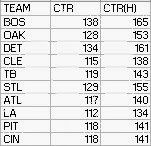
You may be surprised to see the Dodgers as the weakest playoff team in the ratings, but the NL West was not a strong division and the Dodgers' SOS in the ratings is just 28th, ahead of only Washington and Atlanta. LA ranks 11th in MLB in the ratings, with the ten teams ahead all being in the playoffs except for #8 Texas.

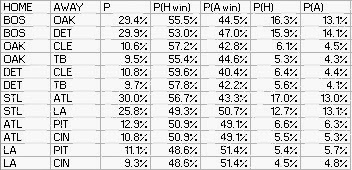
Odds for the wildcard games:


For the Division Series:


For the LCS:


For the World Series:


110-1 for a Cincinnati/Cleveland series.

Put it all together:

Tuesday, April 30, 2013

The Laziest Post I Could Possibly Write

There isn’t any baseball topic that is more of a cop-out, more of an admission that the author is flat out of ideas, then penning an article about one’s opinions on the Designated Hitter rule. I’ve managed to write roughly three posts a month for eight years without going there, so you’ll have to excuse me this one time.

Allow me to put my bias on the table upfront: I support the DH rule. I don’t think it is a perfect rule, but I think that baseball is a better game when the rules recognize that the defensive primacy of the pitcher has resulted in a systematic offensive deficiency. I do not demand that the DH rule be expanded to the National League, but I would certainly not oppose it and would strongly oppose any effort to eliminate the DH from the American League.

I’m not arrogant or naïve enough to believe that I have unearthed some new angle on this topic that you haven’t read before. The DH debate is relatively common, usually picking up extra momentum during interleague play and the World Series, and a large proportion of baseball fans have a strong opinion about it one way or the other. It now has entered the zeitgeist thanks to perpetual interleague play and the notion that universal adoption of the DH is inevitable.

There are two common pitfalls of those discussions that I think are unfortunate, and I’d like to address them before I make my points on the DH rule itself. This post doesn’t have any natural flow, so I’ve gone ahead and used topic headings:

Two Silly Arguments

The first is that participants in a DH debate sometimes accusingly point out that DH proponents tend to be fans of AL teams (or, from the other side, that proponents of pitchers batting tend to be fans of NL teams). It is undoubtedly true that this is the case…but so what? Whenever subjective preferences are on the table for human beings, there’s a good chance that one’s formative experiences or familiar experience will be reflected. To the extent that something is a matter of subjective preference without the insertion of any logical process, does where the preference arises from really matter? And if facts and logic are introduced into a discussion, does the background of the person presenting them matter? Facts are either true or not, and logic is either sound or faulty.

The second is the use of the "real baseball" card...namely, that baseball is somehow not baseball if pitchers are not allowed to bat. I’m not sure there’s a pro-DH counterpart to this argument; there certainly are specious arguments made in favor of the DH, but DH supporters generally don’t try to say that it’s not really baseball if pitchers bat. Arguments of this type are a convenient way to avoid making any sort of logical defense of one’s position.

One of the worst arguments put forth by DH supporters is that "Everyone uses the DH except the National League and the Central League". It’s true, more or less, but it’s still an appeal to the majority. The fact that the DH is widely adopted is evidence that many decision makers felt that it was a good idea, but that doesn’t necessarily make it so. This argument is the pro-DH answer to the "tradition" argument of the anti-DH diehards.

The Historical Trend of Pitcher Hitting

Of course, I’m not above snark and derision myself, and while I’ll try to avoid that for the rest of the post, I can’t pass this one up. You will occasionally see the claim that the DH rule exacerbated the decline of pitcher’s offensive production, and that pitchers did not or were not on a path to become the offensive zeroes they are in modern MLB until the DH rule was implemented. To this I say: nonsense. There are only two things constant throughout the history of major league baseball: the National League tries to position itself as morally superior to its rivals, and pitchers hit worse with each subsequent generation.

By 1972, pitcher hitting (in terms of RC/G relative to the league average, which I call ARG but his conceptually similar to OPS+ or wRC+) had already declined to levels near where it is today; for 1963-1972, the yearly averages were 10, 8, 7, 13, 7, 4, 11, 13, 14, 12. This was a continuation of a trend--pitcher ARG had never dipped below 20 prior to 1952, below 30 prior to 1934, below 40 prior to 1903--with each generation, a new low was being reached, and the race to the bottom was accelerating. (See this post for a more detailed look at positional offense in the twentieth century).

Pitcher ARG has declined further on average since the DH was introduced, but none of the observed figures would look particularly out of place in the 1963-72 figures. I suppose one must acknowledge that it is possible that the post-DH decline is understated due to the possibility that good hitting pitchers are more valuable to NL teams and thus get a greater share of pitcher plate appearances, but any such effect would have to be quite small unless the other forces at work were reversed or strongly diminished.

Radical Change to the Rulebook

A more popular argument against the DH is that it represents a fundamental change to the rules of baseball, a radical and unnecessary departure from the game as it was played for a century. (This is the refined, non-inflammatory version of the “real baseball” argument). Sometimes special attention is given to the first rule in the book, 1.01, which starts "Baseball is a game between two teams of nine players each". Since the DH is a tenth player, this rule is violated, and it is the first rule and thus the DH is completely antithetical to baseball itself.

It’s piling on to spend any time arguing against an argument that most people will immediately recognize as specious, but indulge me:

1. The baseball rulebook is not the Constitution. If you somehow demonstrate that the DH violates rule 1.01, then rule 1.01 can be revised just as easily as the DH can be added.

2. Read literally, nine players doesn’t leave room for substitutes of any kind. OK, you say, what it’s trying to impart is that there are nine players in the lineup for any one team at any time. If that can be read into the rule, then why can’t you just read it as nine players in any particular half-inning? After all, the DH does nothing to change the fact that there are nine players in the field and nine players in the batting order; it simply allows two players to alternate between an offensive and defensive role while sharing one lineup spot. The rules prevent these two players from ever being active simultaneously (viewed from a half-inning perspective).

Getting back to the more general issue of the DH being a radical rule change, I’m not going to try to argue that it’s more or less of a change to the rulebook than other changes that have occurred over the years. I am going to argue, however, that there have been many other changes to the game that have done much more to alter the way baseball is played than has the DH rule. Certainly the dawn of the “live ball era” changed the game much more than the DH, despite not being directly traceable to any rule change. (There are rule changes that certainly contributed, like banning the spitball and requiring clean balls in play, but there is also the composition of the ball and the approach of batters, both things that are not decreed by a line in the rulebook but can change the way the game is played).

The offensive outage of the 1960s that served as the catalyst for the DH rule is another example, and one which it could be argued was more of a direct result of a rule change (the expansion of the strike zone). Many would argue that changing the definition of the strike zone is not as radical of a change as introducing the DH, because it was simply a tweak to a pre-existing element of the game. My contention is that the amount of actual change to the game caused by a rule change is not necessarily proportional to the perceived radicalness of said change. The ultimate example of this is the way that the usage of pitchers as pitchers (not as hitters as in the case of the DH) has constantly changed throughout the game’s history.

Tradition

I’m not opposed to tradition. If something has been done a certain way for a long time, and the end result has been favorable, I have no problem accepting tradition as a point in its favor. But it’s just that--a point, not a game, set, or match. Tradition is also a very dangerous argument to make at this stage in the game if you hate the DH, since nearly forty years of the DH is in the American League has to make the tradition argument close to ripe for those who’d like to keep it around.

I have more to say on tradition, but it ties into the ultimate reason why I support the DH, so I’ll hold off for a second.

Strategy

Proponents of the DH like to claim that it introduces more strategy to the game; opponents sometimes argue the opposite, often citing Bill James’ article in the Historical Baseball Abstract that pointed out the higher standard deviation of sacrifice attempts in the American League. I’m not eager to take a position on which side (or either) is right. I’d grant that it’s probably true that the pitcher being forced to hit introduces more choices for a manager; but some of those choices have obvious answers. If you like strategy, is it more important to have many points at which a choice must be made, or more variation in the choices that are actually made (assuming for the moment that the DH actually does that)?

However, the debate about strategy takes for granted more fundamental questions: what is the optimal amount of strategy in a baseball game, and what exactly constitutes strategy? One could posit that there are three basic types of strategy, which I’ll label by the people responsible for making the choices.

1) Player-level strategy: Decisions about how to pitch to a batter, whether to dive for a ball or not...all of the choices that a player must make while taking the game state into condition

2) Manager-level strategy: Pinch-hit, pinch-run, change pitchers, bunt...the level of strategy that is most relevant to this discussion

3) GM-level strategy: How to evaluate players, which free agents to target, draft strategy...

I suppose Bill James would want us to consider a fourth level, Commissioner-level, which would be relevant to a discussion of the DH, but I’ll ignore that because it’s not particularly relevant to the game on the field.

Sabermetricians have spent most of their time, historically, on GM-level strategy, with Manager-level strategy second. Investigations into player-level strategy have increased in recent years, particularly with the flowering of Pitchf/x data, but still lags behind the other two.

The digression was probably unnecessary, except to set up my opinion--GM strategy fascinates me, player strategy is beyond me, and managerial strategy is interesting but there can be too much of it. Giving the manager more strategic options only interests me if those options allow baseball players to demonstrate their excellence.

Even then, it can be too much. While managers sometimes go overboard in their attempt to utilize their relievers in an attempt to gain the platoon advantage, in theory it’s a good idea. That doesn’t mean it makes for compelling baseball as a spectator. At least in that case, players are being used in a manner that most efficiently converts their ability to value, and the players are better than their peers at the task they’ve been assigned. While the former might be true when strategic choices are made with respect to pitcher hitting, the latter is not. Pitchers are not world-class hitters, and even the lowliest defensive specialist position player would be a standout hitter for a pitcher.

From where I sit, even if I accept that forcing pitchers to hit adds manager-level strategy, I don’t see that as a good thing. I’d rather see players asked to do things they excel at than watch a manager try to make the best out of a player who has no real talent at the task he is forced to engage in.

Conclusion

I don’t begrudge those baseball fans who think that pitchers hitting should be a part of the game at its highest level. While I would prefer not to ever have to watch a pitcher hit, I’m fine with the status quo.

I believe that the DH rule is a correction to a fundamental flaw in the initial design of baseball (to the extent that baseball was "designed"). Initially, the pitcher was a facilitator of action, more like a beer-league softball pitcher than a Greg Maddux. Of course, this lasted for about five seconds--competitiveness ensured that the rules constraining the pitcher would be constantly assaulted until the latter part of the nineteenth century when the rulemakers finally raised the white flag.

I contend that the balance between offense and defense that supporters of pitcher hitting sometimes cite has never existed in baseball and was never possible in a game in which one player’s defensive responsibility so dwarfs that of his teammates. A shortstop certainly has more defensive responsibility than a first baseman, but the difference is not so great as to make the shortstop’s offense a trivial matter when evaluating him as a player. The difference is not even so great as to ensure that when selected in practice, individual shortstops always hit worse than individual first baseman.

With respect to the pitcher, though, the value placed on hitting has been in decline from the beginning of professional baseball. Beyond the importance of selecting pitchers who can retire opposing batters, the relatively unabated trend of pitcher workloads declining with time has reduced the number of plate appearances an individual pitcher gets. At first pitchers were everyday players, more or less, and then there were two-man rotations and three-man rotations, and then the pitchers stopped completing all of their games, and there were four-man rotations...well, you know the story.

Natural selection (I’m sure my use of this term leaves a lot to be desired if you happen to be an evolutionary biologist) dictates that when one trait is so important, it will dominate, and pitching dominates in the selection of pitchers. It dominates to an extent that makes the fact that pitchers are lousy hitters a fait accompli, and it means that the notion of balance between offense and defense for a pitcher is folly.

The DH is admittedly an inelegant solution to this problem. It creates another position for which there is no offense/defense balance (although I don’t hold the ideal of offense/defense balance in particularly high regard). It is a solution that would have been unlikely to have been adopted in the early days of baseball had what I call the fundamental flaw been recognized as such.

I could have included this in the "Silly Arguments" section, but thematically it fit better here--DH opponents sometimes use a slippery slope argument that the DH is a harbinger of two-platoon baseball. Even by the standards of slippery slope arguments, this one strikes me as awfully specious. The DH has been in existence for forty years; there have been no serious proposals to expand the DH beyond the pitcher. There are no other positions that exhibit an inexorable historical trend of declining production with each generation. Given the nature of the game, it is difficult to imagine that such a situation could ever occur. No defensive position is even comparable to the pitcher in terms of its influence on run prevention.

I am all for continuing discussion about ways to tweak the DH; I’ve floated at least one of my own before. One option that is a non-starter as far as I’m concerned, though, is the notion of an eight-man lineup. While proponents like that it would remove the one-platoon DHs, it would fundamentally change the balance between offensive and defensive value for players of every position. It would instantly increase the incentive to carry defensive liabilities and make offensive production a more important factor in selecting players.

The eight-man lineup would cause far more fundamental change to the game than the DH has. Instead of having one offensive position (DH) and one defensive position (pitcher) in which there is no tradeoff between offense and defense, it would tip the scales at the other eight positions more towards offense. Traditionalists would be aghast at the impact of all the extra plate appearances on the record book; that consequence wouldn’t bother me, but perhaps we could shift to eight innings to balance things back out.

That last line is not meant as a joke. In the early 1880s, Henry Chadwick was convinced that baseball would soon be adopting a tenth fielder--a second shortstop of sorts, who’d play on the right side of the diamond and a tenth inning to go along with it.

That never happened, of course, but it’s worth remembering that a number of things that we take for granted in baseball were once anathema to whatever version of "purists" were around at the time they were introduced. The defensive dominance of the pitcher, which was decried well into the 1880s by some people who were upset that fielding just wasn’t as valued as it once was, is one example. What was radical a generation ago is accepted now is tradition a generation from now. Feel free to argue against the DH, but you’ll have to do better than the tradition or real baseball cards, because they could have been played against you in the past, and will be in the future.

Monday, January 21, 2013

Meanderings

* I don’t have anything of substance to add on the deaths of Earl Weaver and Stan Musial, but since both were favorites of mine I feel compelled to write a little something. Weaver of course is a managerial hero to many in the sabermetric community. He predated my time as a baseball fan by a significant number of years, but he still was an influence on me through the writing of Bill James and Thomas Boswell, his own book Weaver on Strategy, and Earl Weaver Baseball, which in its DOS form was the first baseball game I played (even though I’m sure he wasn’t writing the code).

The paragraph that follows is the kind of unsupported by evidence blurb I try to avoid writing, because in many cases you can get destroyed with a little cursory fact-checking. Weaver is famed for utilizing his roster to its fullest, particular his bench -- finding specialists whose strengths could help a club. The value of the bench has been greatly reduced in today’s game thanks to the roster crunch--the extra spots have gone to pitchers. Some of this is a natural result of the never-ending progression towards lighter pitching workloads, but some of it may be traceable to an attempt to counter the Weaver school. Once the bench was smartly utilized with specialists, it was necessary to have a counter-stocked bullpen. The verdict of the powers that be in baseball has been to prioritize stopping the other manager from gaining an offensive advantage through substitution rather than leaving one’s self with the tools to do so. One could argue that Tony LaRussa is the anti-Weaver in this regard.

Stan Musial was of course a great player, one who has gotten the short end of the stick--among his contemporaries on either bordering generation, there has been more celebration reserved for DiMaggio, Williams, Mantle, Mays, and Aaron among outfielders. He’s always been a favorite of mine, though--in fact, I have two framed baseball pictures hanging on my wall (the selection is more due to happenstance than a design to pick these particular two, but I wouldn’t hang a picture on my wall if I didn’t like the subject. One is of Babe Ruth’s sixtieth home run, and one is a picture of Stan Musial and various related Musial memorabilia (bats, uniform, ball, etc.)

* The various sports stories of last week (thankfully, not baseball-related) were a perfect reminder of why I have so little respect for sportswriters as a class (certainly I judge people as individuals, but it so happens that I have little use for the majority of individual sportswriters).

The best attribute of sportswriters is how ignorant they tend to be. When someone writes invective against sabermetrics, or displays a complete lack of understanding of statistics or economics or probability, it is easy to simply laugh them off. A huge number of sportswriters fall into this toss category.

As an aside, if I didn’t come to the table with a pre-conceived dim view of the world view held by most mainstream journalists (non-sports), it would be difficult for me to believe how ignorant they are. When I read news stories about topics on which I am well-informed, it is rare to go through an article that does not contain an outright falsehood, a statement of surprise at something that is blindingly obvious, or a quote from a clearly biased source that is allowed to pass without noting that bias. And when I see this occur in articles about a topic about which I know more than the journalist, it naturally gives me great pause about what I read about topics on which I am seeking to learn more.

Unlike many people inclined to interest in sabermetrics, I am not at all looking forward to the rapidly approaching day in which any aspiring young mainstream baseball scribe will be fluent in sabermetrics and not prone to dismissing non-traditional viewpoints. While this will have a limited positive effect of reducing the amount of idiocy we are all exposed to, it will make it that much harder to simply ignore a writer with cause.

My biggest problem with sportswriters is not that they are ignorant--it's that they are self-righteous, prone to pop psychology, and often downright nasty to their subjects. The new breed of baseball writer will still display all these traits, but without the casual ignorance of logic when it comes to strategy and evaluation of players. The perfect symbol of this new breed is Jeff Passan. Passan is as smarmy and as prone to being a jackass as your garden variety Murray Chass-era hack. But because Passan incorporates sabermetric statistics and thinking as appropriate, he is much more likely to get a pass for being a jerk than is a sabermetric ignoramus.

* The Armstrong and Te’o stories are also worthwhile as an illustration of how different my interest in sports is from the interest of the fictional public to which the stories are written. I have essentially zero interest in the private lives of athletes. I do not pick which athletes to root for because they seem like nice people, or because they have overcome some tragedy in their personal lives--I pick which athletes to root for because they play(ed) for/support the teams that I do, or because I enjoy watching them play the game.

When sportswriters single out a human interest story, it is their way of telling you who to root for. One could look at the roster of any Division I college football team with its 85 players and find someone who has been through a traumatic experience. Frankly, the notion that the death of a college-aged person’s grandmother would be a trauma worthy of making into a story is laughable. Certainly such an event is a terrible thing for the affected person and family, but it is also a fact of life and something that the majority of people in that age group have experienced. But journalists decided that Te’o was special, and that you should root for him--and they almost gave him an absurd Heisman trophy for it.

More broadly, I don’t care if Player X is a jerk to fans (and I certainly don’t care if he is a jerk to the media). I might care if I had any reason to interact with Player X--but I don’t, and the odds that I will ever interact with him are infinitesimal. Sportswriters are often incapable of realizing that the rest of us aren’t affected or interested by whatever inconveniences or petty issues Player X creates for them.

If I discover that Player X isn’t too friendly to fans who come up to him and ask for his autograph, I feel no reason to change my opinion of him. I know that when people who want something that I have approach me, I do my best to ignore them altogether (obviously no one is asking me for my autograph, but we all deal with panhandlers, charities calling for money, family members who need a favor, and the like). How can I fault Player X for behaving exactly as I would behave? Why would I factor this into the degree to which I like Player X, when the only reason I am even aware of his existence rather than that of another 1/7,000,000,000 of the world’s population is his ability to play baseball?

Of course, this can be easily looped back to the big baseball story of the month, the Hall of Fame voting. While the Hall of Fame was broken beyond repair before steroids made it a complete joke, the principle holds: I want to view baseball players as baseball players, nothing more and nothing less. Whatever else they are outside of that is of equal consequence to me as that of a mailman in Topeka.

Tuesday, September 11, 2012

Meanderings

* There is always some grumbling about September roster expansion, and the supposed ills it inflicts on the game, but it seems to have reached a fever pitch in September 2012. There are a lot of calls for some kind of reform, whether it involves severely curtailing the practice or (most popularly) forcing a manager to declare 25 active players at the start of every game.

I don’t have a problem with roster expansion, myself--my preference would be to keep the status quo. I will also admit to not having read all of the pieces that have been written about this, so it is quite possible that someone has prominently beaten me to the punch with the following suggestion. Rather than having the manager declare a 25 man active roster, why not simply limit the manager to using 25 players in a particular game?

Such a rule would give a manager in-game flexibility that would be absent in the case of a pre-declared scratch list. In a close game, he would be free to use extra players in situational roles. In a blowout, he would be able to use his mop up relievers and get young players into the game. But he would not be able to use any more players than he could during the rest of the season.

There are a couple of drawbacks to this rule that come to mind. One is that 25 players is still an increase over the number that is typically deployed during the rest of the season, even in fairly unusual cases. The four excess starting pitchers usually are excluded from game action, especially in the American League. I’d argue that this is a good thing--it allows for some additional substitutions while preventing abuse, but if one is concerned about any change in the behavior of managers, it’s a valid criticism.

The other is a logistical issue rather than a baseball issue, but it would be a little harder to keep track of. Announcers would be completely bewildered as a team approached the substitution limit, and while the omnipresent lineup cards should be sufficient for managers and umpires to keep up, it’s not hard to imagine some confusion arising.

* Everyone has an opinion on Stephen Strasburg. I don’t, really--I certainly agree with the principle of being cautious with pitchers, particularly young pitchers, those who have prior injury histories, and those of extraordinary talent--all three of which fit Strasburg. What I do have an opinion about is the intestinal fortitude of Mike Rizzo and anyone else who took responsibility for the final decision. I consider it a pretty bold stance to take, given that there is almost no outcome in which they do not receive heavy criticism.

If Washington fails to win the World Series, the question of how they might have performed with Strasburg will be raised incessantly. Even a quick sweep in the Division Series in which one win would have not stemmed the tide will not get them off the hook, because psychological factors will be raised (“Strasburg could have won game one and completely changed the momentum”, “The Nationals players would have been more confident with Strasburg available”, etc.) And if they lose a seven game World Series in which Edwin Jackson gets roughed up a couple of times--well, if I was Rizzo, I’d consider hiring a food taster at that point. So far I’ve only discussed the 2012 on-field consequences. A bigger outcry will come if Strasburg gets hurt again, particularly if it’s in the next two years.

What’s remarkable about this decision is the near certainty with which it will be judged as a failure by mainstream observers. Perhaps my imagination is too limited, or my faith in sound reasoning on behalf of mainstream observers artificially low, but it’s difficult for me to imagine a scenario in which the shutdown is considered to be a success. The odds are very good that Washington will not win it all, with or without Strasburg. Steven Strasburg is quite unlikely to have an injury-free career. The takeaway for me is that Rizzo must really believe he’s made the right call.

* I am an unabashed supporter of the World Baseball Classic, so I’m taking it as my duty to update you about the upcoming qualifying tournaments. The existence of these has largely gone unremarked upon.

For the first time, four spots in the sixteen team field will be up for grabs. The twelve countries that won games in the 2009 WBC are automatic qualifiers (Japan, Korea, China, United States, Mexico, Italy, Netherlands, Dominican Republic, Venezuela, Cuba, Australia, and Puerto Rico). The first two qualifiers open up next week.

The qualifiers are four-team double elimination tournaments, the format of which will be familiar to those who watched the 2009 WBC or follow the NCAA Tournament. In Jupiter, FL, South Africa will play Israel and Spain will play France. In Regensburg, Germany, Canada will play Great Britain and Germany will play the Czech Republic. In November, the other two spots will be decided. In Panama City, Panama will play Brazil and Colombia will play Nicaragua. In Taipei City, the Philippines will play Thailand and Taiwan will play New Zealand.

Handicapping these tournaments is silly (after all, the Netherlands beat the Dominican Republic twice in the 2009 WBC). Speaking broadly without knowledge of the actual makeup of the teams, there are clear favorites in the Germany and Taiwan qualifiers, as Canada and Taiwan are much stronger baseball nations than the second-tier European and Asian countries, respectively.

The other two are fairly wide open. WBC rules allow people who could be but are not citizens of a country to play, which allows Israel access to Jewish players. Israel will be managed by Brad Ausmus, and faces a very weak field, so they may be the favorite. Panama played in the first two WBCs without much success. Colombia and Nicaragua have both produced their share of major leaguers, and even Brazil now has their own big leaguer in Yan Gomes.

Just to provide a general sense of how the participating countries have performed in recent international tournaments, here is each country’s rank in the IBAF World Rankings divided by qualifier. (These rankings don’t do justice to countries with strong baseball that don’t field teams in many international tournaments such as the Dominican Republic, and obviously are based on tournament results and don’t tell one anything about the quality of WBC team being fielded. Nonetheless, it’s kind of fun to look at--and it’s even more fun to look at the full ranking list, which includes countries such as Bolivia, Myanmar, and New Caledonia, which I had to look up on Wikipedia. Also note that the top-ranked non-participant, Netherlands Antilles, is included with the Netherlands for the WBC):


It is also worth noting that the IBAF website states that it will now bestow the title of world champion on the WBC winner rather than the soon to be defunct World Cup winner.

Friday, October 28, 2011

Baseball

It has been a part of my life for almost as long as I can remember and it will remain so for as long as I live. For seven months of the year, it is as familiar a part of my life as brushing my teeth or eating dinner, and so it is easy to take for granted. But then one day I wake up and suddenly it is gone, and in the void there is malaise. When the weather is nice, it is played; when it is dark and cold, it moves towards the tropics and away from focus. While it can be used to tell seasons, it scoffs at time while it is played. The competitors dictate the endpoint through their play.

It is a team game, but in many ways it allows the individual to stand and be judged on his own merits. It is a game that, through its variants and offshoots, is quite playable by a large number of people. It is the great American pastime, but it is also the great Cuban passion, the great Dominican pastime, perhaps the most popular import Japan has ever known. We call it baseball, but it is equally beisbol, yakyu, honkbal, pelota.

It is a game simple enough that it can be described (and recorded, on nothing more complex than a piece of paper) discretely--by inning, by score, by out, by baserunner, by count--yet complex enough that there are hundreds and hundreds of people like me who are fascinated by it and spend much of our free time thinking about it, yet we still discover new things about it.

And if you are wired to view the world in a certain way, to try to find and verify patterns, to quantify when possible, and sometimes to find meaning and order through randomness and chance--then sabermetrics is a vessel for enjoying it, understanding it, and celebrating it. To know that what we have seen over the last month is not just unlikely--but rather to have a systematic way of thinking that allows us to estimate just how unlikely--does not detract from it.

Once in a while we are presented with just one more game--one game that is, without question, the end. It almost goes against the spirit of the game to be pettily constrained by a set limit of games that cannot be cheated, unlike the nine innings that often become ten, and sometimes become twelve, and on glorious occasions become twenty, and in theory can be infinite. The potential is often greater than the payoff--but either way, the journey was incredible.

Thursday, September 29, 2011

Playoff Meanderings

I always like to put down some of my thoughts about the playoffs each year, but it’s a challenge to say anything even remotely close to being meaningful. Predicting the outcome of short series is folly (although I’ll engage in a little of this folly later), and you can read that anywhere. So I always try to come up with a different angle to illustrate why the playoffs are subject to such uncertainty.

I’ve certainly had some more interesting illustrations in the past; this one is pretty lame, but for some reason when it crossed my mind in August I thought it was a lot more interesting than I do now. What is the value of each playoff game or series in terms of a regular season game? In asking this, I’m not talking about the weight that should be applied to playoff performance for evaluating individual value, or any such thing...I’m just asking what the implied value is, given the assumption that the regular season standings carry over to the playoffs.

Of course, that’s not how it works--it's a cliché, but every team starts every series out at 0-0. However, I’ll assume that regular season standings carry over (resetting with the start of each additional round to keep things manageable) and the playoff games are weighted in a manner such that at the end of the series, the team that wins the series has a better overall record than its opponent.

There are at least two different ways to approach this increasingly silly scenario, which will be best illustrated by example--treating the series outcome as a binary, or considering the games individually. Suppose that the Alphas enter a five-game division series with a record of 92-70 while their opponents the Betas are 90-72.

First, from the series outcome perspective, if the Alphas win, the series was unnecessary since the Alphas already led in the standings. If the Betas win, however, the series must be given a weight of a number of games such that adding that many wins to the Betas and losses to the Alphas give the Betas a better record. Leaving things in terms of whole games, the answer in this case is three. Giving the Betas three additional wins leaves them at 93-72; three additional losses for the Alphas would make them 92-73. The series could have gone three, four, or five games, making the effective value of those games equal to either 1, .75, or .6 regular season games.

You can also consider this from the game perspective, that is actually looking at the outcome of each game in the series rather than treating the series as a binary win or loss. If the Betas win the above series 3-0, this is pretty straightforward given the two game margin--treating playoff games as equivalent to regular season games leaves the Alphas 92-73 and the Betas 93-72. Suppose the Betas had been 88-74 instead of 90-72, though. In order to bring the Betas ahead of the Alphas (on a whole wins basis), they need five, so each win (and thus each game has to be worth) 5/3 = 1.67 times a regular season game. Now the Alphas have 3*1.67 + 70 = 75 losses and the Betas have 3*1.67 + 88 = 93 wins, so that the Alphas record is 92-75 and the Betas 93-74.

You can see that if the final margin of the series is 3-2 in favor of the Betas, the weight on each playoff game would have to be roughly four times that of a regular season game since the Betas only pick up one win when the playoff series is considered. A 4x weight brings the Alphas and Betas together at 100-82.

This is all just a silly digression, but given the assumptions it is a simple way to think about how the implied value of a playoff game compares to that of a regular season game.

Getting to the 2011 playoffs, let me offer some quick thoughts. I’ll leave the detailed handicapping to those who are better suited for it and also like quixotic quests. The marginal value of more in-depth analysis is limited, but if that’s what you seek, you won’t find it here.

The probabilities that follow assume nothing about home field advantage or pitching matchups, or even true talent for that matter. They are simply based on my crude team rankings, fueled by 25% actual W%, 25% expected W% (from R/RA), 25% predicted W% (from RC/RCA), and 25% from .500.

That formula is also arbitrary. The results should be fairly reasonable, but I’m also eager to disown at the same time, as something of a commentary on the futileness of the exercise...and most especially the bloviating that is done without any logic at all. I’m sure that there are many scribes across the country furiously writing about how certain teams have no chance, never learning the lesson that the differences between major league teams simply aren’t that great, especially after eight of the best have been selected from a 162 game sample.


This method considers all of the playoff teams to be in the top ten in MLB; only Boston (#3) and the Angeles (#8) are on the outside looking in. The Yankees, Phillies, and Rangers are near co-favorites to win it all; NYA and TEX are ranked about evenly, while PHI benefits from the weaker NL field and has the highest odds of winning a first round series and the pennant. Overall, the AL has an estimated 57% chance of winning the World Series. The most likely matchup in the Series is NYA/PHI (11%); the least likely is DET/STL (4%). The rankings imply that the worst playoff team (ARI) would beat the best playoff team (NYA) 43% of the time, which over 162 games is seventy wins. Strictly equating true probability to actual 2011 record, consider the odds that the Padres could win a seven game series against the Indians, and there is roughly the same likelihood of the Diamondbacks winning a seven game series against the Yankees.

As far as my personal rooting interests go, New York and Tampa Bay are my top two choices, followed by Milwaukee and St. Louis. I would be happy to see any of those teams win, have no particularly strong feelings about Arizona or Detroit, and be mildly disappointed if it’s Philadelphia or Texas. But there are no White Sox in this group.

Tuesday, October 26, 2010

The Two Best Events in Sports

You can have the Super Bowl, the Stanley Cup, and the NCAA Tournament (except for the games involving my alma mater). Take the Olympics, the Masters, and the World Cup (please take the World Cup, I beg you). Just leave me the World Series and the Breeders' Cup.

Those two events are by far the most compelling (IMO should have gone without saying) in all of sports. Coincidentally, they both occur in autumn, sometimes even overlapping. This year, barring a horrible streak of rainouts, the World Series will have concluded before the horses hit the track at Churchill Downs, but with both events coming up I will bore you with a few of my stray thoughts.

* I do not have a rooting interest when it comes to who wins the World Series, seeing as I don't particularly care for either club. I do have a rooting interest in the series though--rooting for seven games. There has not been a World Series game seven since 2002--also a series that matched San Francisco against an AL West club, apropos of nothing.

If one assumes that the outcomes of each game of a series are independent, and that both teams are equally matched with constant strength and no home field advantage, then the probability of a series of length N is as follows (geometric distribution):

4 = 12.5%
5 = 25%
6 = 31.25%
7 = 31.25%

The probability of going seven years without a seventh game is (1 - .3125)^7 = 7.3%; it's not a particularly likely streak, but it's not remarkable either. I'd still like to see it come to an end in 2010.

* I don't believe there's much value in handicapping a seven-game series, but I would give Texas an edge, something like a 55% chance of winning. There's even less value in doing so on the basis of full-season team records, but I'll proceed for the sake of discussion.

San Francisco had a better actual W% (.568 to .556) and expected W% (based on runs scored and allowed, .581 to .564), but Texas had the edge in predicted W% (based on runs created and runs created allowed, .557 to .543). However, these comparisons don't take into account strength of schedule, which can be a significant factor between the unbalanced schedule and the AL/NL imbalance.

My crude ranking system (yet to be published, as it will take a long, boring post to explain it) gives the Rangers the edge on two of thee comparisons when SOS is taken into account. Based on W/L, Texas has a rating of 121 to San Francisco's 118 (or a 51% chance of winning a seven-game series with no HFA). Based on R/RA, San Fran leads 129 to 119 (54%). Based on RC/RCA, it's Texas 123 to 110 (56%). Considering that, I think 55% is a reasonable estimate.

* From a preseason perspective, when's the last time there was a more surprising World Series than TEX/SF? I intend that as a rhetorical question, as the answer depends on your own perspectives on the teams before the season. For me, it's probably the most surprising since 2005. I picked Texas second in the AL West and San Francisco fourth in the NL West.

There have been other pennant winners that I did not pick for the playoffs (a long list, in fact, owing to both my misjudgments and the inherent inaccuracy of the accuracy), but I had picked both 2005 pennant winners to finish fourth in their division, so that one stands out.

While record in the preceding season is far from a perfect measure of preseason expectations, it might be instructive to look at the combined previous season W% of the two World Series participants. In the expansion era (1961-), the average pennant winner played .550 ball in year X-1. Both TEX (.537) and SF (.543) were below average, although not by a huge margin. Combined, their .540 W% ranks 31st out of the 49 World Series.

Several series in the twenty-first century have been lower, including 2001 NYA/ARI (.533), 2006 DET/STL (.528), 2002 ANA/SF (.509), 2007 BOS/COL (.500), and 2008 TB/PHI (.478). This should not be too surprising, since the expanded playoffs have had the effect of reducing the same season W% of pennant winning teams.

The highest previous season W% of the era was on display in the 1999 NYA/ATL series, by a huge margin; the two teams had combined for a .678 W% in 1998. 1962 NYA/SF (.614), 1970 BAL/CIN (.611), 1978 NYA/LA (.611, and a World Series rematch), and 1964 NYA/STL (.610) are the other high points. The highest of this decade was surprisingly 2003 NYA/FLA; the Marlins were below .500 in 2002, but the Yankees' 103-58 carried the combination to .563.

The two lowest X-1 W% combinations both involve the Twins. Not surprisingly, the worst-to-first MIN/ATL series of 1991 is last at .429, with the 1987 MIN/STL series at .464. The other series featuring teams that had combined to be sub-.500 in the previous season were 1988 OAK/LA (.475), the aforementioned 2008 TB/PHI, 1967 BOS/STL (.478), and 1965 MIN/LA (.491).

The Twins also account for another dubious distinction; their three World Series are the only ones in the expansion era in which both teams were sub-.500 the previous season. Both the 1965 and 1987 series saw Minnesota playing an opponent that had won the NL pennant in year X-2, but struggled in year X-1 before rebounding and taking the flag back.

I'm now descending from "vaguely interesting trivia" to "absolutely worthless drivel", but it's something I noticed looking over the data. This series features one of the closest year X-1 matches between the two participants, with just one game difference between them (TEX was 87-75, SF 88-74 in 2009). The only perfect match of the era is the 1985 STL/KC series (both were 84-78), with 1965 MIN/LA (79-83, 80-82) and 1980 KC/PHI (85-77, 84-78) also off by just one game.

* I have to admit feeling a twinge of happiness with the Phillies' defeat. The Phillies were, both in my estimation and the conventional wisdom, the strongest NL team in 2010. But when a national baseball writer (even if it is a demonstrated fool like Tracy Ringolsby) picks a team to sweep through the playoffs 11-0, it's hard for me to not root against them. It wasn't just Ringolsby--the Vegas notion that the Phillies were 2-1 favorites to win the World Series is tough to defend logically.

The recent Phillies are among the more overhyped teams of recent memory. Their regular season records have been good, certainly, but not historically special. Winning two straight pennants (combined with the third that some members of the media awarded to them) caused a lot of people to downplay the regular season record.

I looked at the team with the best record in the NL over each three-year period beginning in 1961. Obviously, there is nothing special about this approach, no reason to think that looking at three years is better than looking at two or four or using a different approach altogether. It is a timeframe that fits the Phillies' record, as it captures their world title, their pennant, and their best regular season record.

The Phillies' three-year regular season record of 282-204 (.580) is the best in the NL over the last three seasons, but it ranks 28th of 48 in the expansion era, hardly the record of a historically great club. Recent NL leaders with better marks include several combinations of Cardinal seasons (2000-02, 2003-05, 2004-06) and all of the three-year groups formed from Atlanta's 1990s run.

At least to this point, the Phillies' would-be-dynasty is certainly no better than St. Louis' 2004-2006. The Cards record over that period was 288-197 (.594). Their postseason results were the same as the Phillies: a World Series win, a World Series loss, and a NLCS loss.

Absolutely worthless drivel: the best three-year NL record during the period was 310-176 (.638), compiled by the 1997-99 Braves. If you want one which includes a World Series win, it's the 1974-76 Reds (308-178, .634). The lowest three-year mark by a team which led the NL over that stretch is 260-226 (.535) by the 1982-84 Phillies.

* The main storyline for the Breeders' Cup revolves around Zenyatta. For those of you who may be unfamiliar with horse racing, Zenyatta is a six-year old mare that has raced nineteen times in her career and has never be beaten. Nineteen straight is the longest winning streak in major North American horse racing, surpassing the streaks of sixteen compiled by Citation and Cigar. Most of Zenyatta's victories have come in races against other fillies and mares, but after winning the Breeders' Cup Distaff in 2008 (I refuse to refer to this as the "Ladies' Classic" as is now proper), she became the first female ever to win the Breeders' Cup Classic in 2009.

Zenyatta will be retired after the race, and so there would be obvious interest in the final start of a legend, let alone the fact that she could finish her career perfect and become just the second horse to win the Classic twice (Tiznow repeated in 2000-01). She also could become the first horse to win three Breeders' Cup races.

This will be a tough task, however. The Zenyatta-doubters (a group which I admittedly would include myself in) will point out that she has run most of her races over a synthetic surface and in California, and that her only race against males was the 2009 Classic (which, in fairness, is the premiere race in North America).

Zenyatta certainly has a good chance to win, and I can even get behind the idea that she's the deserving favorite. However, if you let me have a choice between Zenyatta and the field, that's easy. Quality Road, Blame, and Lookin' at Lucky all should get support, and there are some other horses of intrigue that may run (like Japanese star Espoir City, the usual European invaders, and second line three-year olds First Dude, Fly Down, and Paddy O'Prado).

* A related Zenyatta storyline that some racing writers have begun to wring their hands over is whether Zenyatta will be Horse of the Year or not. Horse of the Year is voted on by a group of turf writers, similar to the MVP award. However, it's held in a little higher esteem in the horse racing world than the MVP is in baseball circles. A better comparison is college football's national championship, particularly prior to the BCS.

Like the MNC, the winner can be viewed as the overall champion of the season. In college football, you had conference champions (think divisional awards for horse racing, like Champion Three-Year Old Male, Champion Older Female, or Champion Sprinter) and bowl game champions (think Breeder's Cup race winners). There was no unified way to pick an overall champion, so journalists got together and took a poll. The strange thing is that people found themselves intensely emotionally invested in the outcome of that poll, but so be it.

Zenyatta, whose career accomplishments pretty straightforwardly place her among the all-time greats, has never been voted HOTY. Some folks seem to be concerned about this apparent contradiction, a great performer in an individual sport never voted as the best in a given year.

Historically, it is very difficult for a filly or mare to get the nod as HOTY. Since 1971, when the current honors (the Eclipse Awards) were introduced, only four female horses have won the honor: All Along in 1983, Lady's Secret in 1986, Azeri in 2002, and Rachel Alexandra in 2009. Generally, HOTY goes to the top older male horse (which is logical since older male horses are generally the best horses. It's similar to the MNC usually going to the most impressive champion of a major conference). A three-year old male also has a clear path to the award, by scoring impressive victories over older horses (as done by Tiznow in 2000 or Curlin in 2007) or by dominating races against other horses of his generation (Point Given in 2001).

Generally, horses from other groups will only get consideration if there is no clear choice among the top males. Even fillies/mares having undefeated seasons will get passed over in favor of a worthy male (see Personal Ensign in 1988; she even won the Whitney against males but couldn't beat out Breeders' Cup Classic winner Alysheba for HOTY).

That's pretty much what happened to Zenyatta in 2008. She won all seven of her races, but didn't face males or run off of a California synthetic track. Curlin had an impressive season, winning the Dubai World Cup, the Stephen Foster, the Woodward, and the Jockey Club Gold Cup, becoming the all-time earnings leader in the process. He got HOTY.

The 2009 HOTY race was a little less conventional as three year-old filly Rachel Alexandra won the award. Rachel Alexandra had won the prestigious Kentucky Oaks and Mother Goose against other three-year old fillies, but also defeated three-year old males in the Preakness and Haskell and older males in the Woodward. She was not entered in the Breeders' Cup because her owners did not want her to run over a synthetic track; her detractors claimed it was because they wanted to duck Zenyatta.

Zenyatta certainly had a case for HOTY, and would have been a reasonable choice, but I agreed with the decision to side with Rachel Alexandra. Rachel Alexandra won races all over the country; Zenyatta ran only in California. Rachel Alexandra was a dirt horse; Zenyatta stuck to synthetic surfaces, which simply have not yet reached the same level of importance in American racing. Zenyatta's win over males was admittedly in the most impressive race possible, but Rachel Alexandra's three wins over males were all in Grade I races. Perhaps the best point in Zenyatta's favor was that she won at the classic 1 1/4 mile distance, while Rachel Alexandra's longest race was the 1 3/16 mile Preakness.

Looking at the 2010 HOTY race, Zenyatta will win by acclimation if she can repeat in the Classic. She will also be an easy choice if any horse other than Blame, Lookin' at Lucky, or Quality Road win the race. In the event that one of those colts win, though, it would be tough to deny them the award. Each would have a head-to-head win over Zenyatta (and the rest of the field) in the most important race of the year. Blame boasts victories in the Stephen Foster and Whitney; Quality Road in the Donn, Met Mile, and Woodward; and Lookin' at Lucky in the Preakness and the Haskell.

It is possible that Zenyatta could be voted HOTY even in the event that one of her top three challengers wins the Classic. However, I would hope that voters would do this out of a belief that she was the top horse in 2010, not out of a desire to right the historical record. (*) A horse, especially a mare, can easily be considered an all-time great through finishing second three times in the HOTY voting.

(*) If this post wasn't already too long, I would advance a half-baked theory about how this is exactly what happened in 1998, when HOTY voters went for Skip Away instead of Awesome Again, after passing over Skip Away for Favorite Trick in 1997.

Tuesday, October 05, 2010

Playoff Meanderings

When I write a post to give some thoughts/impressions on the playoffs, I always like to work in a numerical example of why I feel that formally projecting the outcomes is largely a waste of time. These are always repackaged versions of the same idea (assuming independence of outcomes, constant team strength from game-to-game, no home field advantage), namely using the binomial distribution to estimate some sort of probability. Last year I estimated the probability that the Nationals would win the World Series, if only they somehow managed to make the playoffs. This year, I'm going to look at it from the perspective of "How good do you have to be to have an X% chance of winning the pennant?"

I'm going to assume that a team has a constant W% against its playoff opponents, whatever that W% might be, and that the other seven playoff participants are of equal quality. Neither will change from round-to-round. Suppose we have a .500 team. What is the probability they win the pennant given those conditions? That's easy--25%. So how good does a team have to be in order to have a 40% chance of winning the pennant? 10%? 50%?

This chart uses trial and error to estimate that probability. Given the initial assumptions, one can use the binomial distribution to estimate the probability of winning a five game series, then a seven game series. I won't bother reviewing that math because I think most of you probably already know about the binomial distribution, and it is incidental to the point:


The W% listed on the chart is the one that Excel Goal Seek provides, rounded to three decimal places. The takeaway from this chart is that it's just not credible to be supremely confident about which team is going to win the pennant--and yet mainstream fans and pundits will be. To have even a 50/50 chance (given the stated assumptions, of course), a team must be a .606 (98 win) team--relative to its playoff opponents. Even if the playoff opponents are of just .525 true quality, Log5 estimates that the .606 team would be a true quality .630 (102 win) team.

The necessary W% to achieve a given probability only increase of course when the goal is changed from pennant to World Series, and the team must win one five and two seven game series:


I have been amazed by the number of people who should know better who seem to want to hand the Phillies the pennant. The Phillies are clearly the strongest NL team entering the post-season, but I don't for a second believe they have the average 60% chance to win each game that they would need in order to be even a 50-50 shot.

Over the last couple of weeks I've been working on a rating system that takes strength of schedule into account. There's nothing unique about it; countless other people have published similar systems (or the results of said systems) that are based on similar and quite likely better-conceived methodology. It is creatively called crude team ranking (CTR).

Allow me to use these yet unpublished ratings (I need to write up a formal explanation, and that should appear some time during the offseason) to estimate the playoff probabilities. Please don't take the results too seriously, as they have many flaws (they don't consider home field advantage, they don't estimate true talent by using regression or projected performance, and they don't consider specific team personnel). They are based 50% on actual record and 50% on expected record from R/RA and RC/RCA. Still, they offer a reasonable estimate of the various probabilities, and they are very easy to figure with the spreadsheet:


The first column is the team's overall ranking among the 30 MLB teams in CTR. The playoff teams pretty close to being the top eight in CTR; #4 Boston and #8 Toronto did not make the playoffs. Cincinnati has the lowest odds to advance to the second round or win the World Series, but Texas has a lower estimated probability of winning the pennant (since they are guaranteed to play a very highly ranked team in the LCS). Similarly, Philly has the highest first round and pennant odds, but the prospect of a strong AL World Series opponent knocks their championship odds just below that of New York and Tampa Bay.

It's worth noting that even the team with the worst rating in the playoffs (CIN) playing the best team in its circuit is still estimated to have a 41% of winning the five-game series, illustrating again the intended takeaway for this post.

Pushing the system a little bit further still, here are the estimated probabilities of each LCS matchup, along with the probability of each team winning such a series:


Again, the biggest on-paper mismatch possible (NYA/TEX) results in a series in which the underdog has a 40% chance to win, which undersells it just a little because I haven't considered HFA which would go to Texas in such a series. For the World Series:


Now we have a series in which one team has an approximately 2/3 chance of winning (NYA/CIN). If you'd like to see a very evenly matched series, pull for Texas to pull two upsets and make it out of the AL, as the rankings consider them to be about equal with Atlanta and San Francisco, while still being close enough to Philadelphia on the plus side and Cincinnati on the down side to offer an even matchup. The highest individual World Series win probability for the NL in non-PHI series is Atlanta's estimated 46% chance to beat Minnesota.

Other miscellaneous (and equally crude) probabilities:

* Both NYA and TB eliminated in first round: 19%
* NYA, TB, PHI all eliminated in first round: 8%
* All favorites win in first round (TB, NYA, PHI, SF): 9%
* All favorites lose in first round: 4%
* World Series does not feature TB, NYA, or PHI: 26%
* American League wins World Series: 56%

(The rankings favor ATL over SF, but the consensus is definitely the reverse, the two team's ratings are very close, and ATL has suffered key injuries that the system, based on composite regular season performance along, can't account for).

Some random observations:

* BP points out in their series preview that the Reds and Phillies are pretty close in third-order W% (based on RC and RC allowed and adjusted for strength of schedule). My figures agree that it's fairly close, but still have the Phillies in front. However, it is worth pointing out that it is not a matter of the Reds looking better when using what I call PW%; it's the Phillies looking worse. The Reds' W% is .562 and their PW% is .564. They won as many games as you'd expect from their RC/RCA.

* I think the impact of Philadelphia's three starters is being overstated. The Braves should be a pretty good reminder that a collection of great starters is no guarantee of post-season glory (which is not to suggest that winning five pennants is anything to sneeze at). The Astros' staff which is being cited as the last comparable front three lost in the LCS in '04, then were swept in the World Series in '05, outpitched by a group of lesser pitchers who just happened to be having an amazing run. The Astros of 1998 didn't have the same kind of consistent stars that the Braves, later Astros, or Phillies possess, but they did have Randy Johnson plus Mike Hampton, Shane Reynolds, and Jose Lima, and they were quickly dispatched by San Diego.

I'm not saying that great starting pitching is going to harm the Phillies' chances, but it will cause them to be overstated.

* Jon Heyman posted an article with his odds for winning the World Series, which I'll use as an illustration. I don't mean to pick on Heyman, because there are a lot of folks out there who do that already. I've presented the odds based on the charts above as well:


Heyman's odds for most of the teams are fairly reasonable; as you can see, there are three teams we disagree on significantly. Heyman gives Philadelphia 2-1 odds, which is equivalent to having a 1/3 probability. I realize I'm beating a dead horse here, but I can't stress this enough. As demonstrated above, in order to have a 1/3 chance of winning the World Series, a team would need to have an expected W% of close to .600 against their playoff opponents. It doesn't make any sort of logical sense to suggest that any recent team short of the '98 Yankees is even close to that level.

Minnesota at 20-1 is not quite as silly, but is close, for the same reasons. That's a 4.76% chance of winning, and a team would need to have a .425 expected W% versus their opponents to be that big of a longshot. This is not unique to Heymen at all--in general, people tend to overstate the probabilities of the most likely sports outcomes and understate the probabilities of the least likely.

One nice thing about Heyman's odds is that they sum to 100%, almost exactly. I'm actually impressed by that.

* I will close by noting my order of preference for the world championship--you don't care, nor should you, and it has nothing to do with sabermetrics at all. But after seeing the team I was pulling against the most win four out of five World Series from 2001-2005, I find it cathartic to pre-vent:

1. NYA
2. TB
3. ATL
(I would be happy if any of those three teams won)
4. MIN
5. TEX
(I would be unhappy if any of these three won)
6. CIN
7. SF
8. PHI