Tuesday, October 01, 2013

Crude Playoff Odds

In a world where there are plenty of sources for playoff odds that actually take into account the personnel currently available for each team, projected rather than 2013-only performance, pitching matchups, and the like, there is no real reason for me to post this. Nonetheless, here are some very crude playoff odds. The key assumptions:

  • Team strength is constant and is measured by my Crude Team Ratings, using an equally weight of W%, EW%, and PW% regressed with 69 games of .500 
  • Home field advantage is uniform and the home team wins 54.5% of the time

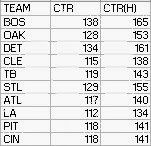
From there, the math is pretty simple and I will present with little explanation. First, the ratings which are used to feed the estimates:


You may be surprised to see the Dodgers as the weakest playoff team in the ratings, but the NL West was not a strong division and the Dodgers' SOS in the ratings is just 28th, ahead of only Washington and Atlanta. LA ranks 11th in MLB in the ratings, with the ten teams ahead all being in the playoffs except for #8 Texas.

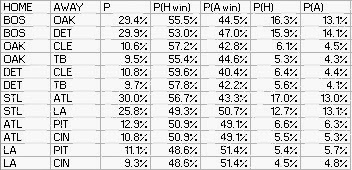
Odds for the wildcard games:


For the Division Series:


For the LCS:


For the World Series:


110-1 for a Cincinnati/Cleveland series.

Put it all together:

Monday, August 12, 2013

Running Aground

The Buckeyes’ 2013 campaign went according to plan.  Everything fell into place in the manner in which one can imagine that coach Greg Beals would have liked it to.  Not everything was perfect--after all, cleanup hitter/closer/top pro prospect Josh Dezse was lost for the season with back issues, never appearing in a game.  Outside of that misfortune, though, there wasn’t much to complain about.  OSU played an unambitious preconference schedule but went 12-6 in doing it.  In Big Ten play, the Bucks hung near the top of the conference, winning 5 of their first 7 series and sporting a 14-7 record.  All projections had them as firmly in the NCAA Tournament field at that point.

And then OSU embarked on the final homestand of the season, an ambitious nine games in twelve days to close the season in style.  Three non-conference powers would visit Bill Davis Stadium (two games against Georgia Tech, three against Oregon, and one against Louisville) as a prelude to the final Big Ten series, which as fate would have it was against Indiana, who led the conference at 15-6.

As you can probably tell from the buildup, it didn’t go well.  The Bucks split with Georgia Tech (despite being outscored 11-5), mustered just one run in the course of getting swept by Oregon (8-1 margin for the Ducks over three games), and lost 6-3 to Louisville.  This showing damaged the NCAA bid, but Ohio still had a clear path to a quality season: win two of three from the Hoosiers and claim a share of the Big Ten title. A 2-1 win in the opener put OSU in a position to do just that, and the Buckeyes carried a 2-0 lead into the ninth inning of the second game, with closer Trace Dempsey riding a long scoreless streak.  He coughed up two runs, and in the tenth OSU surrendered five runs.  In the finale on Saturday, OSU never had a chance, falling 8-1.

OSU still had the #2 seed for the Big Ten Tournament in Omaha, but it was now a must-win.  A walkoff hit batter allowed OSU to pull out the opener with Nebraska 3-2 (only after Dempsey surrendered another ninth inning lead), but Indiana proceeded to drub the Scarlet and Gray 11-3, and the Cornhuskers ended their season 5-0.

Remarkably, after the NCAA Tournament field was announced, Beals took to Twitter to question the selection committee for snubbing his team, citing strength of schedule among his concerns. Regardless of how it may have stacked up in the RPI, OSU finished 73rd in Boyd Nation’s ISR with the 108th toughest schedule in the country--hardly a resume that demands an at-large spot in the field.  And whether any emphasis on recent performance that may exist is in fact logical, going 3-9 in the final three weeks of the season against quality opponents was not going to impress anyone.

Perhaps Beals should devote less time to fretting about the selection committee and more to teaching his team how to run the bases.  Beals’ bizarre obsession with the first and third, two out delayed steal of home did not taper off in his third season on the job.  The staff’s emphasis on rewards for aggressive baserunning have resulted in a team that gives away more outs for nothing than any team I’ve ever had the misfortune of watching play regularly--on any level.

The crowning achievement of Beals’ baserunning blunderers came in the non-conference game against Louisville. OSU trailed 6-3 in the bottom of the ninth and the leadoff batter reached.  After the second batter flied out, the third batter swung and missed at a 1-2 pitch.  The runner at first was thrown out attempting to steal second.  I was at the game, and I was so befuddled by what I had witnessed that I sat in my seat staring at the field for a good ten seconds attempting to process it all.  Had the runner thought it was a wild pitch and known that the Cardinals still needed to record the final out?  Wait, there was only one out, that doesn’t make any sense.  Maybe it was actually ball four, and the catcher threw down...no, it was only 1-2.  I attempted to rationalize the irrational, and was left with the cold reality--Greg Beals is a mid-major college baseball coach with the mind of a little league coach, who is teaching the sturdy sons of Ohio to run the bases like a band of untamed Yasiel Puigs.

For the season overall, OSU was 35-23, for a .603 W% good for fourth in the Big Ten (Indiana led at .754).  Their EW% of .571 was fifth-best (Indiana, .790) and PW% of .547 only sixth-best (Indiana, .723). 

OSU’s offense scored 4.6 runs/game, well below the Big Ten average of 5.2 and good for just ninth in the conference.  They weren’t good in any key offensive category, batting .259 to the B10’s .276, drawing a league-average .1 walk per at bat, and mustering a .082 ISO to the .087 average.  The lack of power was infuriating to watch, but in context the Bucks don’t look so bad--the power outage has infected all of college baseball and made dull, low-scoring games in which the threat of an instant is largely off the table all too common.  OSU’s nineteen homers was right at the B10 average, while Indiana clubbed 53.

Senior Greg Solomon and sophomore Aaron Gretz split the playing time at catcher fairly evenly (138 and 183 PA), with Gretz hitting much better although still below average (-2 RAA).  Solomon’s approach is nearly unspeakably dreadful (4 walks and 26 strikeouts), although I hate to say that about an OSU athlete.  First base was a weak spot offensively as Dezse’s bat was sorrowly missed.  Senior Brad Hallberg had his worst season with a -5 RAA performance.

Second baseman Ryan Cypret, also a senior, turned in an average season with the bat which for him ranked as something of a disappointment but his 0 RAA still placed him second on the team among regulars.  Freshman third baseman Jacob Bosiokovic showed promising power earlier, but wound up with a very pedestrian season line of .273/.327/.369.  Senior shortstop Kirby Pellant was sure-handed with the leather and rapped out some base hits, but did little else with the bat for a .301/.340/.392 line.  Pellant was drafted in the 26th round by the Angels.

No Buckeye had a rougher 2013 than Tim Wetzel, who first lost his leadoff job, then his center field spot.  The junior slumped horribly with a .215/.292/.304 line (-15 RAA) over 229 PA.  Senior Joe Ciamacco took both of Wetzel’s prior roles, but didn’t set the world on fire either (.274/.354/.294 for -4 RAA).  The lone OSU regular who hit better than the Big Ten average was sophomore right fielder Pat Porter, who hit .296/.369/.472 for +10 RAA.  The closest thing OSU had to a regular DH was junior Mike Carroll, who turned in -4 RAA over 108 PA and decided to forego his final year of eligibility.

Given the poor offensive performances, you might surmise that Ohio did not get much production from the bench, and you would be correct.  Freshman Troy Kuhn was the infield reserve de jour and second baseman in waiting, and rode a hot start in BA to a .272/.323/.293 line--that's 2 doubles in 92 at bats. Freshman first baseman Zach Ratliff forced his way into playing time at the end of the season and showed promise with power and what appeared to be a good approach at the plate despite just 2 walks; Ratliff’s .323/.364/.452 line came over just 33 PA, but still enabled him to rank second on the team with +1 RAA.  Freshman shortstop Craig Nennig got all of his playing time in the non-conference portion of the schedule thanks to a complete lack of offense (.125/.143/.146 over 53 PA).

It was pitching that enabled OSU to compete in the Big Ten race. Unfortunately, none of the three weekend starters will be returning for 2014.  Senior Brad Goldberg, in his first season pitching for Ohio State after a transfer and eligibility headaches, emerged as the #1 pitcher, with +11 RAA backing his 6-1 record.  Goldberg was able to overcome spotty control (5.1 walks/9) thanks to stinginess with the homer (just 2 in 81 innings).  Goldberg was selected in the 10th round by the White Sox.  Classmate Brian King was OSU’s #2 pitcher in Big Ten play and the lefty had a fine season with +11 RAA thanks largely to outstanding control (just 1.1 W/9).  Junior Jaron Long was a contender for Big Ten Pitcher of the Year in 2012, but fell to #3 starter as his BABIP reached .360. Still, his control (1.7 W/9) and keeping the ball in the park (3 HR in 100 IP) allowed Long to remain a productive member of the staff (+5 RAA).  After a good start in the Cape Cod League, the Yankees snapped him up as a non-drafted free agent for a $50,000 signing bonus (Long’s father Kevin is the Yankee hitting coach).  The pitcher used consistently as a midweek starter was freshman Jacob Post, and while he struggled in the results department (7.63 RA in 31 innings), his 7.6/2.6 K/W suggests he has future promise.

OSU’s bullpen was also strong particularly the top three, anchored by sophomore closer Trace Dempsey, whose final 1.50 RA in 35 innings was driven up by a couple shaky outings at the end; he still led the team with +13 RAA.  Sophomore lefty Ryan Riga stamped himself as a candidate for the 2014 rotation by  recording +11 RAA thanks to 7.4 strikeouts and 1.7 walks per nine over 46 innings.  Senior Brett McKinney, an erstwhile starter, lived up to his big arm by recording +9 RAA over 48 innings with a 10.8/2.6 K/W rate.  McKinney was picked by Pittsburgh in the 19th round of the draft.

In middle relief, sophomore Greg Greve (another potential 2014 starter after working in that role in his freshman campaign) was effective (3.65 RA) in 24 innings.  Senior sidearmer David Fathalikhani saw his workload drop significantly, but was effective in a near ROOGY role (3.38 RA over 18 innings in 23 appearances).  Junior Tyler Giannonatti served in mopup duty (6.06 RA in 33 innings).

All-in-all, OSU was simply unable to overcome the complete lack of offense.  While Beals has drawn raves for his recruiting, he’s yet to put much talent that he’s recruited out of high school onto the field.  Among OSU regulars, only Gretz , Porter, and Bosiokovic were Beals recruits out of high school.  On the pitching staff, only Greve and Post fit the bill.  Beals has patched the rest of his roster with transfers, often to good effect, but there’s been no evidence yet of a talent pipeline to keep the ship afloat.


Entering 2014, OSU will have to replace the entire starting rotation and several key lineup slots.  Even if Josh Dezse can be counted on to return to help both, it seems quite unlikely that OSU will be as good as they were in 2013.  With a NCAA Tournament drought that now stretches four years (the program’s longest since 1983-1990 and the first multi-year drought in that timeframe) and proof from Indiana (the Big Ten’s first College World Series representative since 1984) that much better accomplishments can be achieved, the clock is ticking on Beals’ opportunity to turn potential into victories.
Saturday, July 13, 2013

Sports Data Research

I will be writing occasional columns this summer for the Sports Data Research blog. Sports Data Research was co-founded by Shane Holmes, one of the regulars at the old FanHome Sabermetrics board. They specialize in college football, college basketball, and soccer data, but the blog will cover a variety of sports topics. Currently posted are my piece on OPS and a column by Nicholas Patrick on alternative formats for basketball games, so the scope should be fairly wide and of interest to readers of this blog.

Walk Like a Sabermetrician is not going anywhere, although the posting frequency may be a bit reduced (in fact, the posting frequency has been reduced recently anyway, for reasons having nothing to do with the SDR columns). This will still be the outlet for all of my technical posts, my meanderings, and, of course, Great Moments in Yahoo! Box Scores.

Sunday, June 30, 2013

Great Moments in Yahoo! Box Scores


Screengrab from 9:11 AM, a good 16 or so hours after this game ended.

Wednesday, June 26, 2013

Offensive Percentages and Overall Productivity

This one is really dated, so I’ll just point out that it was written in 2010.

Joe Mauer had the biggest power season of his career in 2009, and it was not surprisingly also his best overall offensive campaign. Still, Mauer was a very productive batter in 2006 and 2008 with much less power. How unusual was that? How good of a hitter would we expect someone of his relative H/W/P profile to be? Those are the kinds of questions that this discussion touches upon.

I was inspired to look into this by a Twitter conversation I had in mid-late June (2010, mind you). I had read a comment on BTF about how the Twins must be terrified by Mauer's power drop this year given the huge investment they made. This led me to tweet that Mauer had been arguably the best position player in the league in '06 and '08 while hitting for relatively little power, and that his value was not necessarily dependent on power. In addition to the power drop in '10, he'd seen his walk and single rate declines, and that was sapping his value as much as losing power.

Someone responded by saying that 2009 was the first season in which Mauer's power relative to the league was equal to his value relative to the league. I responded that his ISO ratio was much lower than his wRC ratio, and this led to a tangent about the slope of ISO versus runs.

However, the question that the conversation brought to mind was the typical relationship between overall offensive value and the share of that value that is derived from hits, walks, and power.

I'm going to look at all players 2000-2009 with 400 or more at bats in a season, and compare their H/W/P to their RG. Then I'm going to run some cringe-worthy regressions (but be comforted by the borderline freak-show nature of the topic itself), and then we can all find something more productive to do.

The strongest correlation between any of H/W/P with RG is H%, which has a r of -.64 (P% is +.54 and W% is +.34). H% has a negative correlation with RG; the higher the proportion of positive linear weight contribution (I'm going to stop using that mouthful and start calling it "value", but please remember what I really mean is positive linear weight contribution), the lower the RG.

The best way I found to estimate H/W/P from RG is to start by simply estimating H%. The best correlation for a simple regression comes from using the natural log of RG:

eH% = -.1883*ln(RG) + .9242

where RG = (TB + .8H + W - .3AB)*.324*25.2/(AB - H)


I'm a little hesitant to even mess with logs in such a trivial application, but it gives a slightly better fit and it does a better job of matching the high RG outliers (read: Barry Bonds). Fretting about those outlier Bonds seasons may be problematic from a statistical perspective, but I think it has some grounding in baseball logic. It makes intuitive sense that H% will be lower as RG increases; the upper bound of observed seasonal BA is around .420. A .420 hitter with little power (.08 ISO for a .500 SLG) and moderate walks (.475 OBA, which means .1 W/AB in this case) will only have a 9 RG. In order to be a historic-level performer, one has to excel in both batting average and secondary average. The log regression seems to strike a balance between the two.

After H% is removed, it's hard to find much of a correlation between RG and P%/W%. I figured the percentage of non-hit value contributed by power (P%/(P% + W%)), and its r with RG is just +.06. So I decided to keep it simple and simply use the average for everyone: 63% of non-hit value comes from P%, 37% from W%:

eW% = (1 - eH%)*.37
eP% = (1 - eH%)*.63

These estimators work pretty well for players when grouped by RG. In the chart below, "2" indicates players with RG between 2-2.99; "4" for 4-4.49; "4.5" for 4.5-4.99; "7" for 7-7.99, and so on:


Really, I could have just dispensed with the estimators and just used the chart to estimate H/W/P for players of different ability levels, but where would be the fun in that?

Here is Joe Mauer's actual and estimated H/W/P breakdown for 2005-2009 and the first half of 2010 (which is current, as of the moment I actually wrote this):


To this point, Mauer's 2010 has been just about his worst offensive season (without an adjustment for league scoring context). Mauer has always had a higher H% than the average player with his RG. Even with his 2009 power surge, he had a lower P% than expected (24 to 31%).

Mauer's career high P% is 24%. That is the typical value for a player with a RG of 4.8-5.3. So even in Mauer's best power season, his P% is below a typical P% for a player with a RG lower than that in Mauer's worst overall season (yes, that is an awful sentence).

While Mauer has an unusual profile, I wouldn't describe it as extremely unusual. The four largest deltas between H% and eH% in 2000-09 all belong to Ichiro Suzuki, with H%s over 75% with expectations in the high 50s. Juan Pierre and Placido Polanco are two other players whose names pop up on that list. Limiting the group to players with RG > 7, Mauer is the only batter whose name appears twice in the top ten deltas.

Looking at the P% deltas for players with RG > 7, Mauer's 2006 was the largest (19% actual, 29% expected), and his 2009 was tenth. Barry Bonds' 2002 even manages to rank fifth despite 45 homers, because 22% of his value came from walks.

Whether Mauer is able to approach the value projection implied by his contract without retaining some of his power games is a question best left for the projection mavens. However, just looking at his career to this date, Mauer's power has always made up much less of his value than a typical player at his level of offensive productivity, and his 2009 was no exception (albeit slightly less extreme). At least to this point, Mauer has been one of the most valuable hitters in the game while relying on power to the same extent as a league-average performer.

Sunday, June 16, 2013

Saturday, June 08, 2013

Monday, June 03, 2013

Offensive Percentages

I wrote this post (and its companion which will go up at a later date) in 2010, but didn't like it enough to publish it here. However, this topic came up on Twitter recently, and Sky Kalkman wrote up his take on it here. Since I already had this written, I thought I might as well add it to the conversation.

In one of his early national Abstracts, Bill James published a method that estimated the percentage of a player's offensive value (actually, his Runs Created) which was derived from Batting Average. Since RC is simply (H+W)*TB/(AB+W), one can calculate a player's RC in lieu of power and walks by taking H^2/AB. Dividing this by RC gave James an estimate of what percentage of his contribution came from base hits alone.

James' method was later expanded by Gerry Myerson in the Big Bad Baseball Annual to estimate the share of RC derived from walks and power. James Fraser (whatever happened to him, anyway?) later applied a similar approach to Extrapolated Runs.

Let's start with a simple, static linear formula, basically Paul Johnson's ERP. This is not the most precise run estimator available, but it's easy to work with and is good enough for this type of application:

RC = (.5H + TB + W - .3(AB-H))*.324 ~= .49H + .32EB + .32W - .1(AB - H) = .59H + .32EB + .32W - .1AB

It is pretty easy to split this up into the basic components of hits, walks, and power (as shown). However, there is the little problem of the negative runs that are charged for outs made. If you lump them in with hits, the share of offense contributed by base hits will be driven down. If you ignore them and compare to total RC, you'll end up saying that the percentage of value contributed by hits, walks, and power combined is greater than 100%, and by a different amount for each player. So instead, I’ll look at the contribution of hits, walks, and extra bases towards the positive linear weight value, and ignore the negative from outs. I make no claim that this is the optimal way to do this, but it seems like the least bad alternative.

Since we're not dealing with actual RC figures anymore, we can safely ignore the .324 multiplier and make it real simple:

Pos = .5H + TB + W = 1.5H + EB + W

The percentage of positive linear weights contributed by hits, walks, and power (extra bases) is straightforward:

H% = 1.5H/Pos

W% = W/Pos

P% = EB/Pos

I'm not quite sure how to express this coherently, but these percentages don't really represent the portion of a player's overall offensive value arising from those three components. It represents the share of a player's absolute positive Runs Created that arises from those three components. If you tried to apply this approach to absolute RC, it would fall apart, because you have to do something about the outs. If you tried to apply this approach to a baselined metric (RAA, RAR), it would really fall apart. You would have players with a negative denominator, and thus negative percentages, players with negative hit contributions but a negative denominator resulting in positive percentages, and all manner of results which wouldn't make much sense.

The bottom line is that, as Bill James explained when he introduced his version, you can't use the percentages literally. That doesn't make these percentages useless, but it does make them more of a freak show stat than they otherwise might be. Still, if you don't treat the percentages as literal, but as abstractions, and only compare them relatively between players, they have the potential to yield some insight.

Let's begin with the major league percentages for 2009 [I'm going to display these as (H, W, P) from this point]:

AL: (61, 15, 24)
NL: (61, 16, 23)

Simply collecting base hits is responsible for 60% of the positive run value in the majors. It's not that batting average is worthless--if you break OBA and SLG down into the portions derived from base hits and walks (OBA) or power (SLG), the hits portion is more important. The problem with BA is that it doesn't add much additional information given that you already have the more complete metrics. Getting hits is still a very important part of offense, and no sabermetrician will ever tell you otherwise.

Of course, the way I've split things up is to put the first base of every hit together. You could split off singles on their own, and leave the first bases of extra base hits in the "power" grouping, and of course the share of positive value credited to "power" would go up. Personally, I think this kind of approach is more useful if the extra bases are spun off.

In any event, players will have much more extreme profiles than the league as a whole. Consider these four players from the 2009 AL:

Suzuki: (76, 7, 16)
Punto: (60, 30, 10)
Pena: (41, 22, 37)
Delmon Young: (71, 5, 24)

Ichiro lead in H%; Punto led in W% and trailed in P%; Pena led in P% and trailed in H%; and Delmon Young was last in W%.

The disclaimer about abstraction can be illustrated by example. Compare Suzuki and Punto. 7% of Suzuki's positive linear weight total came from walks, while 30% of Punto's did. Suzuki 's walk rate was .059, Punto's was .145. If we could use the percentages literally, than Suzuki's overall rate of offensive productivity would be proportional to .059/.07 = .843 and Punto's .145/.3 = .483. It doesn't matter whether you use RC/PA, RC/O, or any other sensible overall rate--you're not going to be able to reconcile the players' ratio in those metrics and the players' ratio in non-sense units. You might be able to tie them loosely to an overall metric--after all, they can be tied back to "Pos" by definition. However, the positive linear weight values on their own, without subtracting or dividing by outs in any way, don't capture the full extent of a player's offensive productivity.

Next time, I'll look at how H, W, and P% look for hitters when they are grouped by overall productivity. To be one of the very best hitters, a player is going to have to contribute in all three areas--a player like Ichiro gives us some hint as to the upper limit for a player with very little secondary contribution. Looking at hitters breakdowns by quality groups will not provide much of analytical value, but it does help in identifying players with unique styles.